Monday, June 17, 2013

Elsa Schiaparelli, Fashion Icon


Elsa Schiaparelli, or “Schiap” to her inner circle, was one of the world's most prominent fashion designers between the two World Wars. And while her rival Coco Chanel often refered to her as just that Italian artist who made clothes, she rose to prominence with what was considered at the time, provocative and progressive creations.  Writer Leo Lerman described her in an article as "a headline attraction in the international glitter-glamour freak show of the late twenties and pre-war thirties.” It was during this time, at the height of her Studio's production, Schiap created much of what came to define her iconic style.


Her designs, testing the definition of wearability, began to break up the literalness of the fashions of the day. From where we are now, experiencing the Red Carpets populated by the design statements of Lady Gaga and Bjork, Schiaparelli's work seems demure, even polite, but at the time, she was making groundbreaking steps in the deconstruction of fashion. She disregarded the boundaries of acceptability and just let herself create.  


A women with many friends including Marcel Duchamp, Alfred Stieglitz, Edward Steichen, Raoul Dufy, Man Ray even Salvadore Dali, her work was laced through with influences from Dada and Surrealism. One of her most famous pieces was an evening dress made in 1938 titled 'Tear,' made in collaboration with Salvador Dalí. The painter designed a fabric printed with a torn flesh motif, pale strips peeled back to reveal a visceral red, that first appeared in Dalí's 1936 painting 'Three Young Surrealist Women Holding in Their Arms the Skins of an Orchestra.'


She had many firsts over the course of her career. She mixed real jewels with fakes, and plastics with gold. She introduced the first jumpsuit, wrap dress and the idea of paper clothes. She invented foldable eyeglasses, brought new materials to couture including latex, straw, rubber, cork, mattress ticking, and made the first shoulder bag for women. Collaborating with Dali, to make early wearable electronics, they designed an evening bag that features a tiny battery-operated street lamp on the outside,
Schiaparelli is famous for her devotion to shocking pink.
Much as we need to see her clothes in the time they were made to truly understand their genius, Schiaparelli herself is also a product of her time. Her twelve commandments for women, starts out with the brave and progressive advice, "Since most women do not know themselves, they should try to do so." But as her commandments continue they begin to show their age. She tells women to only shop alone or with a man. Why? Because women have an inherent tendency to be jealous. And while she tells women to "buy little and only of the best or the cheapest," she also says "never fit a dress to the body, but train the body to fit the dress," which sounds horribly body-phobic to modern ears. Her position on women and clothes was complicated, and sometimes intentionally provacative, when describing the meaning behind fashion she once said "When you take off your clothes, your personality also undresses and you become quite a different person- more true to your self and to your real character, more conscious, sometimes more cruel."


Schiaparelli's work left waves in fashion that are still felt to this day. Interestingly she also seems to be an early progenitor of a common theme in clothes today: the skeuomorphic or as the fashion industry would call it trompe-l’oeil shirt. These are meta garments intentionally made to reference another category of clothing while still maintaining their conceptual distance. Much like t-shirts printed to look like tuxedos,  these sweaters were made to resemble flouncy blouses. In fact these knit sweaters are what boosted her career, and brought her designs to a wider audience.


After the trials, and liberations that came with WWII, including women now frequently working traditionally male jobs, women had changed. Her theatrical designs no longer appealed to the more practical post war woman, and sadly in 1954 Schiaperelli's house went bankrupt. To keep herself afloat she was one of the first designers to liscense her name to be used by Playtex girdles, Cutex Nail Polish, Congress laying cards, Sealey mattresses, Longines watches, Vat 69 Scotch,  Kraft Italian Dressing, as well as  lingerie, handbags, jewelry, eyeglasses, table lines and chewing gum. 

Schiaparelli was a powerhouse of design, a whirlwind of a personality and a women unafraid of her own abilities. Her ground breaking passion is an inspiration to this day. For more on Schiaparelli check out her autobiography "Shocking Life" or Patricia Volk's  book "Shocked, My Mother, Schiaparelli and Me".


Monday, June 10, 2013

The Color of Numbers

Synesthesia, the translation or mixing up of sensations, often affects the way people see and experience colors, but what is the experience like ? Wikipedia uses this image to illustrate how  some syntesthetes experience, but not exactly see, their colorful numbers. 


Interestingly many syntesthetes don't know this is the way they see numbers or letters until they realize others don't percieve numbers this way. Back in February, Numberphile, a math and number centered YouTube channel, interviewed Alex Dainis, a gene researcher, media creator and grapheme-color synesthete, who discribed her revelation about her synesthesia.  Her freshmen year in college, a professor asked if anyone saw numbers with colors and her gut reaction was to say no, of course not, numbers don't have colors but instead each digit, 0-9, was associated with a personality. But her moody and brooding 9, she realized felt that way not because she didn't get along with 9's but instead because her brain always showed her 9 in a dark marrow red.


This video is  a fascinating look into how an actual syntesthete experiences numbers in everyday life, and how this cross wiring influences what she feels is intrinsically right or wrong when it comes to numbers and objects in the real world.  It also opened a flood of comments from viewers with the same condition but with completely different colors associated with each of their numbers. Thankfully all this data was handed over to number nerds.   From that outpouring came these fantastic graphs which shine a light on how our brains tend to mix things up.


With the data all laid out trends start to appear. The most universally common associations for  0 and 1 are black or white, but 0 can also be perceived as transparent. Another clear trend is that as the numbers increase in value so  do the diversions in standard colorization. The three primary colors of red, yellow and blue, are all strong contenders for many of the numbers, but green  makes up a large proportion of the votes. The associations get more and more complicated until we reach 10, or 1 and 0 together, in which black and white again dominate. 


The video was so popular with viewers,  Numberphile recently went back to meet with Alex to ask her some questions. Here are some questions: Are you making it up? How do larger numbers look? What about primes? or Does your color association go both ways? This follow up video is great for anyone who has ever wanted to ask these types of in depth questions about Synesthesia and how our brains use color to categorize and label the world around us. 

Sunday, June 2, 2013

LED's replacing Paint?


LED's could replace paint as the future of color in architecture. This is the Busan cinema center in Busan, South Korea, a new creation by the architects at Vienna based Coop Himmelb(l)au. This building is an architectural feat in more ways than one. The structure includes an impressive 85 meter long cantilevered roof, which is  twice as long as the wing of an Airbus. "Once we [start building] architecture like aircraft wings we will no longer need columns," said Wolf D. Prix, the a co-founder, Design Principal and CEO of  Coop Himmelb(l)au. 

The engineering involved in this kind of build is fascinating, and has even garnered an International Property Award in Leisure Architecture.  We are interested in the  colorful  LED underbelly of the wing. The over head field of color is the architectural focal point of the complex which includes a series of indoor and outdoor spaces focused on the experience of film.   The roof itself becomes a projection screen made up of  transparent glazing and metal  mesh structures to show off color.

At night the LED screen breaks up the solidity of the building and evaporates into a sweep of colorful animations of fluid dynamics. It bucks the trend of colorless glass and steel and, instead of relying on the colorful lights of advertisers, incorporates the visitors experience of color directly into the building. Perhaps the dreaded future of cities packed with colorless metal buildings will be rescued by the increasingly cheap, flexible and dynamic technology which allows for modern applications of color. With such an amazing screen/building now up and running,  lets hope motion graphic and video artists are given the opportunity to create site specific colorful works individual to that screen. 


images © duccio malagamba 

- Emily Eifler, Writer, Colour Studio
- Jill Pilaroscia, Principal, Colour Studio


Tuesday, May 28, 2013

The School of Color


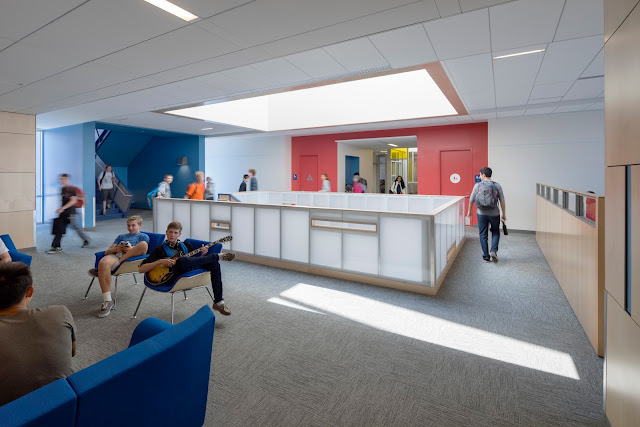
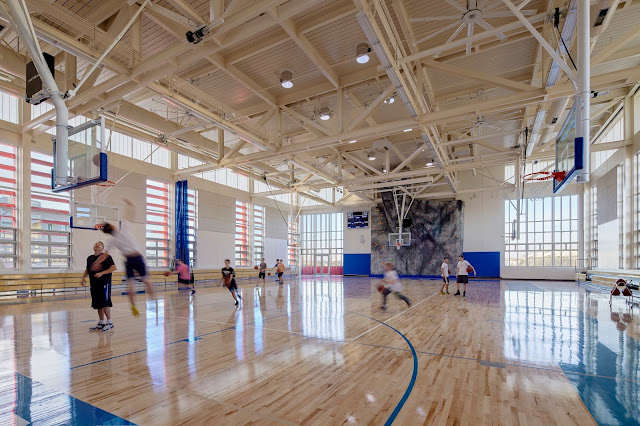
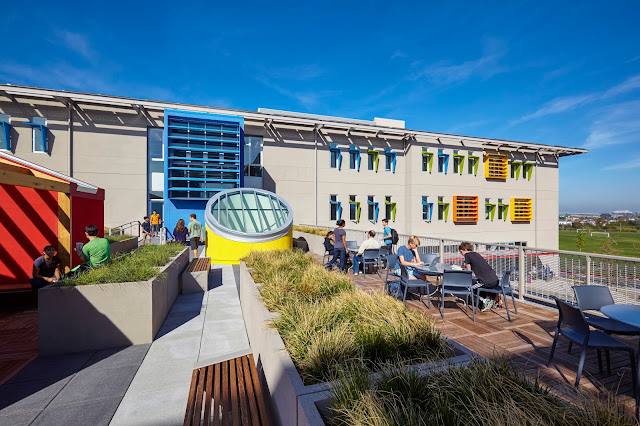
We have written posts  before about the importance of color in school environments so this week we wanted to show you a fantastic new school overhaul using color to its every advantage. Braamcamp Freire Secondary School just outside of Lisbon  was originally built in 1986 as five prefabricated buildings. Prefabricated housing and architecture have come along way in recent year but back in the 80's it meant something close to late 1960's brutalism: grey unicolor structures with poor lighting and that special lingering prefab smell. 

Recently this school has undergone a massive and colorfully considered overhaul. The reclamation project was a result of Portugal's "Modernisation of Secondary Schools Programme," a country wide initiative aimed at not only making schools more useable by reorganizing spaces and adding visual cues to indicate the use of different spaces, but also to  make school buildings available  for community based functions. 


There is a crisis in education these days over everything from tests scores, kids being bored, what should be taught in our new information technology world, summer breaks, and teacher review systems. While color and architecture can't address all of those factors, it can play an important role in making the kids feel like they want to go to school to learn.  This school has gone from five disconnected building with little thoughtful interaction to an energetic campus.

Such bright colors might seem at first seem too primary, too saturated, or too intense, but that's just the point.  When hundreds of kids have to sit in the same building day after day after day, especially one that was formerly entirely grey concrete,  the  new colorful environment  contributes visual stimulus  to  combat the cognitive stupor.    The bold pops of primary colors reorient the eye from  an undifferentiated mass of grey concerte to individual spaces, and pathways.   

Not just visual components were added in the hope of keeping the kids on track, the overhaul addressed auditory problems as well. As anyone who has ever been in a fully concrete building can attest, sounds tend to travel. The architects added  acoustic panels and special punctured concrete blocks to cut down on hallway noise which can be a huge source of distraction for the kids. 


Project: ES / EB3 Braamcamp Freire
Location: Pontinha, Lisboa, Portugal
Client: Parque Escolar, EPE
Total built area: 15,800 m2
Project and construction period: 2010 – 2012


- Emily Eifler, Writer, Colour Studio
- Jill Pilaroscia, Principal, Colour Studio

Sunday, May 19, 2013

Color to the Max

Urban Interiorities by Virginia Melnyk and Tiffany Dahlen
This Japanese nightclub's candyland concept was drawn from Japans colorful youth and fashion culture centered in Harajuku, a neighborhood in the Shibuya ward of Tokyo, Japan. Harajuku is world famous for its colorfully maximalistic street fashion, so building a night club which would cater to these adventurous tastes was definitely a challenge. Designed by Tiffany Dahlen and Virginia Melnyk, American architects and both recent graduates from the University of Pennsylvania School of Design, the building houses a dance club and also contains a restaurant, bar, and several lounges. 


Harajuku street fashion
Melnyk and Dahlen were asked to create a whole "new approach to the night club experience." When asked about the project Melnyk described the inspriation thusly. "It is not by chance that the project looks sweet like Candyland — much of our inspiration came from the sensations of taste and our perception of a visualization of these sensations. It is our hope that this project will push boundaries and leave viewers with a wider imagination of what architecture and design can be.”

The buildings use of color and texture is groundbreaking. Called wacky by many, this nightclub is braver and more visually satisfying that most. Aided by ever advancing computer aided modeling and rendering techniques, the pair generated undulating petal-like surfaces that go beyond just a visual experience and seem to elicit the smells and taste as well. Each flavor of texture fades at its edges like an evaporating scent just before the next colorful texture kicks in and the senses are once again invigorated.

More than just maximalism  this building  embodies another important aspect of Harajuku fashion. With little distinction drawn between what clothes are supposed to be worn by men and which by women this fashion style goes a long way toward the elimination of cultural gender boundaries, similar in effect to the newly cross gender audiences of shows like Adventure Time and the recent anime-like reboot of My Little Pony.  This building does away with distinctions of gender, the distraction of being feminine or masculine, cute or serious, and instead is just visually interesting.  It kills that old fashioned idea that anything made by women or associated with women is niche, by women for women, while products, shows, buildings made by men are universal, for everyone. The building is a feat of form and function, audience and creators all wrapped up in one stunning package. 


- Emily Eifler, Writer, Colour Studio
- Jill Pilaroscia, Principal, Colour Studio


Sunday, May 12, 2013

Paseo Marítimo de la Playa Poniente, Spain


City shorelines tend to be a problem when it comes to the design and maintenance of public spaces. With all that water and sand to contend with theses areas are often left as concrete slabs cut through by periodic access stairs. Take this beach, the one and a half kilometer long promenade originally ran side by side with a four lane thoroughfare and a series of ground-level parking lots. An attempt to improve the strip in the 1970's led to the years of degrading paving and a concrete sea wall which obstructed both views of the beach and physical access. The infrastructure made the beach hard to use, yet another example of public space being ruined by too little consideration.  When the city of Benidorm, in the south of Spain, held a design competition to spruce up the promenade after committing ten million Euros to the project, this eye-catching beauty was the result. 


The city wanted a potent solution to reinvigorate the space, improve the public use of the beach and create a visual relationship between the beach and the juxtaposed office high rises.   Amazingly, thats just what they got. The new promenade uses a rainbow of colors and curves reminiscent of the surf itself to bind the two spaces together. Colors add visual prominence to the walk way when seen from the neighboring sidewalks and store fronts inviting pedestrians  to cross the street and enjoy the view. The diagrams and models shown above illustrate how the serpentine from reflects and thus eases the transition between the urban space and the natural one. 


If you want to know more or see other public spaces that have been similarly improved through  the use of color and architectural intervention visit Public Space, the European Prize for innovation in public space architecture. 


Credits:
DEVELOPER:
Generalitat Valenciana - Ayuntament de Benidorm
AUTHORS:
Office of Architecture in Barcelona
COLLABORATORS:
Luca Cerullo - Dirección de Obra Juan Calvo - Estructura


- Emily Eifler, Writer, Colour Studio
- Jill Pilaroscia, Principal, Colour Studio


Monday, May 6, 2013

Publicolor

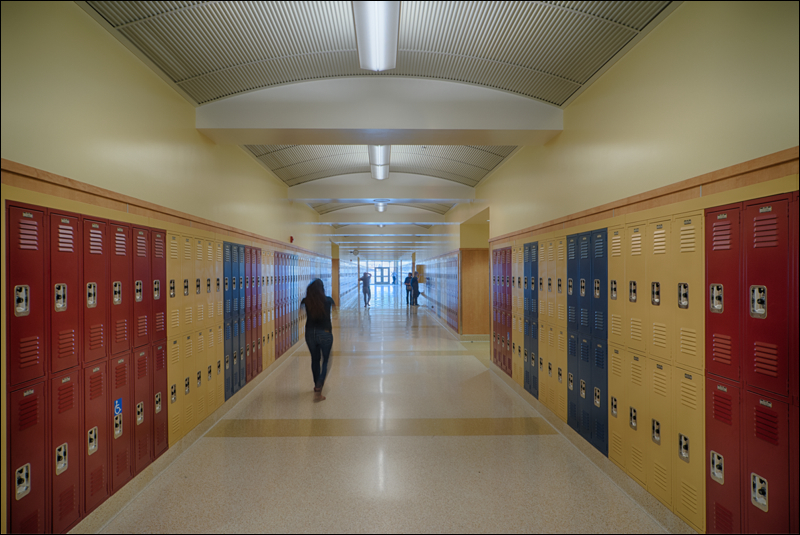
When did the play, color and creativity of kindergarden get bleached from the educational environment?   In primary schools for young children teachers typically decorate their rooms with student art and visuals that relate to the curriculum.    The thought is  lively images  are fun and help children create positive associations with learning. But what about high schools? Some  high school have let the color drain away and schools have become an institutitional shadow of their former selves. Its definitely a problem, and Publicolor is here to help.

The before
Publicolor is a not-for-profit  organization using color and design based programs to help under-performing schools reinvigorate their campuses.   The kids experiencing these enhanced environments increase college and job preparedness. They  believe, and they have the numbers to back this up, that the colorful revitalizations done in collaboration with the students gives students a feeling of ownership of the school. Students involved in these projects are twice as likely as their fellow students to successfully graduate from high school: "94% of Publicolor’s students, 97% of whom are minorities, graduated on time last year. This compared to 58% at their schools."

and after of  Publicolor school painting project
When people like and care about their spaces it not only cuts down on more minor negligences of graffiti and litter, but also gives the students and community members a feeling of civic pride. In this way Publicolor aims to help interrupt the cycle of poverty that plages many of these schools students, their families  and the neighborhoods they live in. 

Publicolor  reminds us of something we all know inherently, the environments we are surrounded by, whether by our own design or by circumstance, change how we think and feel about ourselves, others, and our work.   Environments  can influence how creative, how engaged or rewarded we feel. Color alone cannot give concentration, passion or excitement to the students in these schools, no more than it  can overhaul a poorly operating office or hospital. Color instead is a visual marker of the social reform, acting as a reminder of the communities goals, needs and abilities to come together to create something meaningful. Color encourages and supports us, but ultimately acts as a banner of commitment, past and present, to our places and the people we share them with. 


- Emily Eifler, Writer, Colour Studio
- Jill Pilaroscia, Principal, Colour Studio